In the 200 or so products I’ve worked with over the years, there have been some truly excellent strategic plans developed by the teams involved – cutting insight, opportunities and challenges uncovered, winning strategies innovated to meet them.
However, regardless of the quality of that strategic thinking, undoubtedly the greatest threat comes after their creation – in their capture and communication.
Inevitably it seems, these delicately nuanced arguments get boiled down into bullet points, charts and tables. In doing this, words and phrases that might challenge are replaced with the deliberately ambiguous. Important connections between insights and ideas are ripped apart and clumped in lists or abstract diagrams. Bullet points reign supreme.
We’re left with a strategic plan that is a pale semblance of the thought that went before. To the outside observer it appears to be largely generic and is hardly inspiring to senior stakeholders who must bless it, or to those who must ultimately implement it.
Sound familiar?
There is a better way - it’s called strategic narrative and it means capturing your strategy – with all of the nuances and interconnections - into a strategic “story”. Read more....
If there is any one thing we know in pharmaceutical marketing, it’s that the pressure to differentiate has never been greater; whether it’s with physicians to encourage change, or with payers to prove value.
We all say this, but do we really mean it? Do our organisations fully understand it, and do we “put our money where our mouth is”?
Here’s an edited version of a talk that marketing guru Seth Godin at TED (you can see the full talk here). I believe it superbly captures the nuanced reasons why we need to change our approach to product development and commercialisation.
Seth’s key point is that products can no longer just be very good or better, they need to be remarkable; what he would call a “purple cow”.
I believe this is superbly relevant in modern pharmaceuticals.
In developing products, so much of what we do is driven by attaining regulatory approval; which by it’s nature looks to measure products by established, often composite, parameters – like an ACR score in rheumatoid arthritis, or an Overall Survival score in oncology.
However, with so many disease areas now well served by existing treatments, being very good, or maybe even marginally better than what’s already out there is simply not good enough to warrant access from payers and adoption by prescribers. You need to be remarkable, or what the French Transparency Commission would call innovative.
This means that, for example, bringing yet another product to market for RA with a “TNF-like” ACR score is simply not good enough, regardless of how hard that benchmark is to attain. For products to succeed they must find a remarkable benefit backed by a plausible rationale applied to a discrete patient population.
While this has always been the formula for success, in the past products were able to succeed with only one or two of those three elements. Not anymore. If you want to tap into the Otaku that can break your product into a satisfied market, you need to give them something to be excited about.
To create such remarkable products there are two things that we need to do and Seth spells both of them out:
1) Employ better design With respect to the pharmaceutical industry this refers to the development programme. It means that instead of settling for what will secure regulatory approval (not necessarily easy in the first place) we need to go beyond and find other ways of communicating the remarkably different benefit that our product can provide within well defined patient groups. It means that just showing better FEV1 scores in respiratory or Relative Risk Reduction in cardiovascular disease is no longer enough; you need to find novel or unconventional parameters to express how what you’re bringing to the market is remarkably different.
No doubt this translates into extra cost and resource, as realistically this data needs to be generated in addition to what regulators will demand. It also requires more thought, planning and ingenuity to pick what those new parameters should be. However, that’s the modern cost of success, and as Seth says “Design is free when you get to scale” (i.e. the marginal cost of this is incidental compared to the value it creates).
2) Take more “risks” Spend more money on endpoints over and above what is required, and that are not guaranteed to add value.
Rather than bringing out a mass market product “for everyone” within a given disease area, create a medicine that will have Otaku; that will have greater benefit in smaller, discrete patient populations and that may at first only be adopted by sub segments of your customers. Flagrantly and intentionally risking, dare I say it, being niched (shock)!
But while his philosophy does have elements of inherent risk, it is by no means as risky as the conventional industry standard “safe” approach: to show that a new medicine is marginally better than what has gone before it on established parameters, and that it is appropriate for use in as many patients as possible.
This is modern pharmaceutical development suicide, yet lemming after lemming continues to line up.
If you were a payer, would you replace a functioning standard of care (SoC) in all your patients for a new premium priced product that was only marginally better? I suspect, that like many payers do, you would at best reserve it for use in SoC failures and look for patient sub-groups in which to restrict its usage.
If you were a clinician, would it really be worth braving the risks and hurdles of adopting a new product for one that is at best marginally better than what you already have and know? Even if you were an innovator, would the “safe” product I describe ignite the Otaku within you?
As Seth describes, the truth of this complex and cluttered modern world is that only Purple Cows that can ignite Otaku give themselves a chance to cut through and succeed. Is your ambition to be risky, or very good? The choice is yours.
Here's a great video that talks about the continued emergence of social media.
Even though it's 6 month old (an age on the social media trajectory), the facts and figures in it are eye-popping.
At this point, social media is still predominantly a tactical channel, but what I love about it is its ethos; customer driven (like diffusion), not promotional message driven. In effect the New vs the Old pharma marketing model.
Read more....
There’s an interesting debate that’s been ongoing about pharmaceutical companies’ approach to data publication. Unusually it’s actually spilled over into the mainstream media (BBC Radio 4 news) and is captured in a head to head article called Is the conflict of interest unacceptable when drug companies conduct trials on their own drugs? (BMJ 2009; 339:b4949 and b4953).
The protagonists of the argument are Ben Goldacre (arguing YES to the proposition) and Vincent Lawton (arguing NO). You can access their viewpoints via the hyperlink in each of their names.
Having heard yet another pharma spokesman be made to sound like a henchman of an evil empire on the radio, I had a closer look at each of their arguments. Read more....
When I talk with people about the New Pharmaceutical Marketing and how it's based on Diffusion of Innovation, they say "Hey, makes sense. Like it." It explains a lot of the problems that old pharma marketing couldn't tackle and gives us a way to attack many of the new ones.
My suspicion however, is that they may subconsciously think "But is this really totally proven, or is it a marketing fad? I mean, every one else is still doing it the old way."
"Diffusion of Innovation" sounds sexy, but it’s no passing fad. It is based on years of work around the laws of adoption of innovation, on the concepts laid out in Everett Rogers seminal book The Diffusion of Innovations.
While there is new thinking in today’s frameworks, the reality is that the enormous evidence base behind the ideas that we discuss is actually very well established. And, though it’s sometimes overlooked, a vast amount of the work we cite and build upon was conducted in medicine, in healthcare. Read more....
We all like to think about how we can encourage or speed up adoption of a brand or idea. What we rarely think about is how to stem the flow of people "de-adopting" or discontinuing it's use.
You only have to think about this if things go really wrong. Don't you?
Not so! Truth is that even for the newest brands and ideas, people are discontinuing as other people are becoming true adopters. The more you can stem the tide of this discontinuance, the steeper your overall adoption (and sales) curve will be.
So if you're really serious about making a product launch successful, or perhaps trying to remedy a brand disaster, you need to have a proactive look at where and how your discontinuance will, or is, happening.
We've written a little paper about it which might give you a few more ideas, which you can download by clicking hereRead more....
The chart above is from a peer reviewed publication Babor E et al. Psychiatr Bull, 1996.
Look at how influential 'representatives' and 'advertising' are versus 'colleague recommendation', and contrast that with what's at the heart of traditional pharma marketing strategy. Read more....
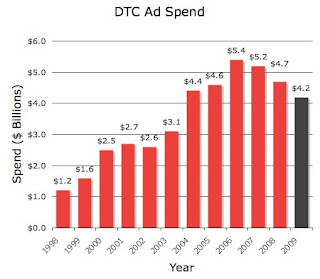
The chart above comes from this article on Pharma Marketing Blog. A first reaction would be to blame the downturn on the same thing everything else is being blamed on: the credit crunch / financial meltdown. However, the dip started in 2006, so while this may become a contributing factor, it isn't the main cause.
Anyone working in pharma will know that thinner pipelines and higher market access hurdles mean companies have been looking for efficiencies. My belief is that under this lens, traditional promotion - of which TV DTC has to be the most obvious example - is starting to look like the emperor with no clothes.Read more....
So far in this blog when it comes to the future of pharma marketing, I’ve mainly talked about us working to a better understanding of how pharma marketing really works - by adopting elements of diffusion theory and word of mouth (WoM) marketing.
There is another big change that’s already happening in pharma, and as with WoM it also shows how the consumer model aped for so many years is woefully inadequate – it’s Market Access.
“Back when I were a lad” learning the pharma marketing ropes in the 90’s, reimbursement and pricing was simple. The answer was always “premium price” regardless of the question. The only tricky bit was figuring out how much you could charge for something first in class. You called the pricing guys in at the last minute to do some research and put a price on it, and hey presto.
Such a scenario is clearly laughable today. As professor Michael Rawlins, head honcho and chief ball-breaker at NICE put it: “The industry has to accept that just because new drugs are licensed does not mean that the health service wants or needs to buy them.” Ouch. But as a tax (or insurance) payer though, you’ve got to admit he’s on the money.
I realise this isn’t news to many in pharma. These days we’ve all got departments focusing on ‘market access’ or ‘managed care’; some companies doing better jobs than others.
But here’s my challenge – how long should it stay like that; with a marketing department and a market access department? Sure, you might need a small army of people to go smoothing the numbers with to HMOs or Primary Care Trusts, but at a central strategic level there is no real division.
It’s still about marketing strategy, it’s just that we’ve finally added in price and access (volume) into the equation, along with the customers most interested in these points.
For us old-timers (hey, I’m still in my 30’s!), on first sight this can be a little scary: new customers with new jargon to deal with who seem hell-bent on not paying for our products. The way I like to think of it though is as one big negotiation and the fun bit is that it isn’t necessarily all about price.
Let me give you an analogy. I was talking to someone a few weeks ago who sold her car on ebay. By self-admission she is a neat-freak who had every skerrick of information on the history of that automobile, as well as a ton of photos detailing its condition. The car was in good order and so she put it on at a premium price.
In the auction it went at full asking price to a bidder who said that the reason they paid top-whack was because, sure it looked like a good car, but she was the only seller who had fully answered their gazillion questions and so they were comfortable to buy at that price.
The same thing can work with payers. Have the right data answering their troubling questions (like, just how much better than generics is it?) and you too can snap up a great price. Other levers to think about with your access strategy include the patient segment you’re going to target and proof of the buckets of money you can save them elsewhere in the system.
It takes a little practice to start getting this thought process in train, but rather than thinking of it as menacing hoodoo, we need to see it as a fun strategic challenge that’s part of the role. The “kids” growing up as product managers today no longer see the distinction. Get on board or get outdated – it’s the future I tells ya! Read more....
News on the Merck/Schering ENHANCE study popped into my inbox today, and the explanation of where the acronym ENHANCE came from gave me a wry smile.
As you would have no doubt have guessed, ENHANCE stands for Ezetimibe aNd simvastatin in Hypercholesterolemia enhANces atherosClerosis rEgression Obvious really.
We need some rules on these acronyms. The FDA don't seem to be approving many molecules, so maybe they could get stuck in here.
Sticking the word 'enhance' in the title and picking out the middle two letters is bad enough, but the N in the middle of an 'and' while ignoring anything out of 'simvistatin'? Apart from that I'm aware of at least one other trial with the same acronym. Surely not a case of clumsy marketing? Read more....
The buzz phrase 'word of mouth marketing' has been pretty hot over the past few years and understandably so, after all, 'colleague recommendation' is regularly cited as the greatest influence over a physician adopting a new therapy. Also WoM has the allure of being cost efficient and contagious - very sexy indeed.
However, while the flashy 'WoM' turns heads and gets all the attention, it's the greyer figure of 'Innovation Adoption' that I've come to realise is really the big player sitting quietly, but omnisciently, in the background.
Of course, it's not actually an either / or situation with these two. 'Innovation Adoption' describes the whole process that someone goes through in adopting an innovation (like a new medicine), and Word of Mouth can be a player in a number of the steps within the process.
Where I'm going to with all of this is that in the quest for a marketing model that describes how pharma marketing really works, Word of Mouth is a lot better than the poor rip off the outdated consumer model. However, it's really Innovation Adoption that's the daddy, and it might sound a little strange, but I've been getting pretty excited about it.
This has been going on for a while now (should I tell my wife?) but some recent work with a client in the telecomms industry rekindled the fire. On the face of things you might say telecoms and pharma don't have a lot in common. But by applying adoption of innovation principles to their product, we not only got some great insights to their challenges and opportunities, but also saw a lot of direct parallels between the industries.
All driven by the fact that both sectors are in the business of driving the adoption of technical innovations, not selling a new brand of frozen peas or alco-pop. Read more....
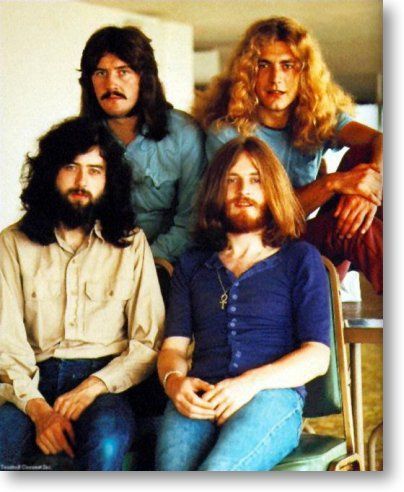
WOAH, before you click away, this is not a post written by some crazed seventies rock fan. This is about a great little word of mouth story that I heard spun just the other day.
For those of you not in the UK, you probably haven't heard that the rock giants Led Zeppelin are performing a one off-concert in London on November 26th. I've got to confess that this leaves me pretty cold (aging rockers with big hair) but what grabbed my attention was when I heard a sound-bite from Harvey Goldsmith, the famous promoter of the revival.
Harvey showed the skills of the cunning marketer he is by crafting a nice little word of mouth story. He obviously instinctively realises that people think and talk in stories, not bullet pointed sales messages. Hey, I'm no LedZep fan, but even I can remember the story weeks later. Quoted on the radio (and below on the BBC website here) about the concert even before details were announced, he said (I loosely paraphrase):
"I originally asked the guys if they would get together and perform for 30 minutes, but they got together together and after a week's rehearsal, things sounded so great that they decided to do a full set. It was all really sparked off by Jason, the son of the original drummer (John) who'll complete the original line-up"
Why's this so clever? What Goldsmith could have done is just list the key selling points of the band; number of albums sold, bands influenced, etc. But instead, he created a story about how they reformed and the role that son of the original drummer has played in this. "Aging, out of practice rockers" becomes "they've aged like wine", and "stand in drummer" becomes "carrying on the rock dynasty".
If you're a marginal LZ fan, or even just a general follower of guitar based rock, you already knew about the band's status and achievements. But now there are extra points of interest; the chance to be a part of this magical reformation and see John Bonham's spirit live on. Just as important, you've got an interesting story to pass on to someone else like you, who might also decide to go, and even pass the story on again.
This one concert is so popular that there have been 25 million (yes, million) ballot applications and over 120 million hits on the website for only 20,000 tickets.
So what's the takeout in pharma?
Have an honest look at your marketing messages. Are they in the form of a genuinely interesting story that a customer would want to listen to and pass on, or are they a list of bullet pointed sales messages? If they're the bullet points then take a leaf out of Harvey's book. Read more....
To understand the role blogging could play in pharma marketing, you need to understand the implications of web 2.0; where customers are no longer talked at through promotion, but for the most part just talk between themselves.
To fully appreciate what this means you must participate first hand in the ‘blogosphere’ (how well could someone who’s never watched TV understand TV programming or advertising?). Scanning a few blogs (like this one) doesn’t count. You need to get your hands dirty, by at least engaging in conversation through leaving comments, or preferably even starting your own blog(s). It’s easy and free; choose a mix of subjects, from work to outside interests, and if you like remain, anonymous.
Having done this for a few weeks, you’ll start to grasp the fundamentals of the medium. In essence, blogging is about informal conversations rather than promotional lectures, and there are different categories of these conversations.
While a ‘blog conversation’ between a pharma company and consumer is extremely difficult to create (regulations, speed and style of medium), a closed ‘blogversation’ between a company and health care professionals is far more manageable, although not without steep challenges; e.g. does your subject area have the scope to generate a daily or weekly blog post, and who’s going to write it?
The blogversation that most marketers tend to want to get in on is the one between consumers or customers themselves. Trying to infiltrate this blogversation through fake blogging (flogging) is marketing suicide. See my own blog post on that here.
However, observing and learning from those conversations, and even reacting positively to them, is becoming a crucial piece of the marketing mix. Basically, if these people are successful at blogging, they have become opinion leaders, and need to be treated the same way you would treat other key opinion leaders.
In short, blogging, while still in its infancy, is a preview of where modern communication and media is headed. As such, even though there are many barriers (including our own mind-sets) in the way, it’s crucial to really understand this medium rather than either ignore, or crudely trample all over it.
This is part of a fuller review of pharma blogging which you can find here.Read more....
Here's a little video that summarises beautifully how traditional marketing is failing.
I experienced an example first hand last week when Vodafone, my mobile network, rang me. The scripted call-centre guy, who I could hardly hear, started off by grilling me with a questions to establish my identity; off putting considering they rang me, and it could be anyone calling me as I try and shop with the kids.
Then he told me that the call was to thank me for being a loyal Vodafone customer (I've been with them for a while) and as a reward offered me this deal: free phone insurance for three months, after which this would turn into a policy that will cost me £6 a month.
A great demostration of how to insult your customer. This was quite obviously no "reward", but rather a very clumsy way of trying to upsell me some insurance I don't need, using shmarm that wasn't even as good as that of the "advertiser" in The Break Up, above. Hard selling to me is bad enough, doing it under false pretenses even worse
It does remind me of a few opinion leader meetings I've seen though. Genuine scientific discussions or thinly veiled selling schemes?
Last weekend, The Sunday Times Style magazine ran this feature The Stealth Sell (let me know if the link has gone and I'll post the text). Overall, it's an interesting read that succinctly taps into some key live issues in Word of Mouth marketing. It's also fascinating to see that it was in a lifestyle section, not business or news.
What it does by the end of the piece however, is to lump together some forms of marketing that really aren't in the same ball-park.
The bit that I think it gets right, is to point out the deception that's going on by those people who want to exploit the power of word of mouth, rather than work with it. The author sites PayPerPost, who are paying bloggers up to £10 per post to endorse set products.
“This is a new way of looking at advertising,” says Tim Draper, a PayPerPost stakeholder. “You put an ad inside the text, and it’s more subtle.”
It's not more 'subtle' Tim, it's more 'deceitful'.
Whether you think paid posts are wrong or right (is deceiving someone the same as lying? Semantics - they're both wrong) it doesn't make good business sense for anyone involved, apart from Tim and PayPerPost:
If the blogger is a serious writer who wants people to heed their opinion and come back to their blog (even for commercial reasons), then these paid posts will slowly but surely kill their legitimacy (their brand), and with that their audience. Who wants to read stealth ads masquerading as blogs in their spare time? Perhaps because blogging is online - you can't look these people in the eye to see if they're lying, and there's no editorial control - people who read blogs are ultra sensitive to sniffing out flogs (fake blogs).
For the company ultimately paying for the post, this is also bad for their brand - unless you want to be known by your customers as the brand who has to pay people to lie about it, presumably because it's not that good, or because you're just the sort of big, evil corporation who likes doing this sort of thing
Where the article goes off track a little is the way it ends off, introducing the shady new art of "tryvertising", actually known for a hundred, if not thousands of, years as "sampling":
“Several years ago, a well-known trainer company went into working-class areas in America and doled out free shoes to a handful of ‘opinion-former’ kids aged between 14 and 18,” says Mark Ratcliff of the research consultancy Murmur. “Then they sat back and waited for demand to flare up. They told me where they appropriated that idea from,” he continues. “Crack dealers.”
A nice little anecdote, but what separates this "new tactic" from paid posts, and to my mind takes it out of the 'Stealth' category, is that no-one is being deceived. Some selected kids got some new free trainers; they could then make up their own minds whether they wanted to recommend them, or even wear them in the first place.
Lessons for pharma
If you're thinking about online strategies - don't pay for posts or flog. It'll not only demean your brand, but I'm sure the regulators would rightly take a pretty dim view of deceiving customers and consumers
Transpose this to what we do with customers and opinion leaders. Stop looking for ways to make them spout a promotional message, and start thinking of how you can create a situation where the right people in the right context can make up their own minds about your brand. Much more powerful and a win for everyone.
There's a subtle but important difference between these two terms that can change the way you work with opinion leaders. In a meeting recently I saw this "penny drop" for a room full of experienced industry folk.
Advocacy is when a customer believes in your brand so much they'll recommend it over and above the competition to others (hence 'brand advocate') Thought Leadership is when a truly powerful opinion leader influences the way we think about a disease While it's nice to have brand advocates at a local level interacting with prescribers, too many pharma marketers then try and convert thought leaders into brand advocates, to the point where they start to obsess about whether the thought leader is predominantly prescribing their brand.
There are two points to be made here:
A true thought leader will not let themselves become a brand advocate. By doing this they lose their perceived objectivity and with that their influence. It's thought leader suicide, so save your breath
You don't actually want them to. Thought leaders can do something far more powerful (commercially for your brand) than advocates: they can change the the world thinks about a whole disease. The way we think about a disease defines which treatments are most relevant for that disease. For example, if asthma was still a disease to be treated symptomatically - what use would there be for Advair / Seretide?
Understanding this elevates opinion leadership to where it should be; a strategic imperative rather than a tactical message channel. It also explains two of my pet hates:
the phrase "thought leader management" (sounds patronising and/or logistical)
clever dicks asking what the ROI (return on investment) of working with thought leaders is. I'm OK with ROI - for tactical programmes like Reps, advertising or even advocates. But for thought leaders it's like asking what the ROI of your position statement or insight research is.
So blogs; if marketing commentators aren't talking about them, they're writing them. But does this make blogs and other social media a force that pharma can't ignore? Should we take the step out into the unknown, potentially risking all sorts of backlash to become involved in this modern communications phenomenon?
Talk to anyone involved in social media and they'll look at you like an idiot if you question the impact of blogging. There were moments like this at the International Word of Mouth Conference earlier this month in Amsterdam. During one pro-blogging presentation, Dr Peeter Verlegh of Erasmus University openly challenged the presenter on what percentage of the general population could actually be involved in blogging - there was stunned silence.
Over a few posts on this fledgling blog I want to explore these questions, challenge a few assumptions and by the end see if there is a way forward for pharma, blogs and social media. I say challenge assumptions because I feel that there's an accepted wisdom building about the power of blogging that reminds me of the blind faith behind the first dot-com bubble (but then I also thought the same about that new search engine Google, so just goes to show...). At the same time, the power of word of mouth in healthcare is undeniable and social media would seem to tap into it. Let's see where we get to....
Read more....
Having attended last year, my key thought going into this one was:
"is it just me, or is everyone else using WoM as another media tactic, rather than a fundamentally better way of approaching marketing strategy?"
An avalanche of presentations of the various buzzmarketing agencies resoundingly confirmed the the former. I note that George Silverman also experienced this at WOMMA in the States late last year - see his insightful blog post here.
I believe in 'live and let live' for the buzz guys, but my concern is that "WoM" as a concept is getting niched as a kooky direct marketing tactic, rather than fundamental strategic shift. My presentation (download from here) followed this line of thought and showed how you can build a WoM centred communications strategy.
The good news from IWOMC '07 was that there seemed to be an acceptance that we need to move things 'upstream'.
So the questions I'm left with are:
Why isn't WoM being talked about in this way?
Who else out there (apart from George) is trying to do this?
How can we get this discussion going at events like WOMMA and IWOMC?